Mount Allison is a community where students learn from one another, build meaningful connections, and grow both personally and academically. Each person arrives with their own background, experiences, values, and way of communicating. Those differences strengthen our campus and create opportunities to broaden our understanding of ourselves and others.
University policies and community standards reflect our shared values and help create an environment where everyone feels supported, respected, and able to contribute fully to campus life. These resources can help you understand your rights and responsibilities, access support, and navigate concerns when they arise.
- Academic Integrity Policy — sets the University's standard for student conduct in academic matters
- Student Code of Community Standards and Accountability — sets the University's standards for student conduct in non-academic matters
Addressing concerns: what can I do?
Examples of behaviour/relationship challenges you may encounter:
- "My roommate and I aren't seeing eye-to-eye, and I'm not sure how to address it."
- "A situation with a friend has escalated, and I don't know what to do next."
- "Something happened at a party, event, or in residence that doesn't feel right."
- “Someone's comments, jokes, or behaviour have made me feel excluded, unwelcome, or uncomfortable.”
Ask yourself some reflective questions:
- How is the behaviour affecting me?
- What would I like to see happen moving forward?
- Is there information or context that I may be missing?
- Do I feel comfortable addressing the concern directly?
I think I can resolve this myself, where do I start?
Helpful communication strategies
You’ve got this! Below are some helpful tips to guide you through a difficult conversation.
Tips for difficult conversations
- Choose a time and place where both people can talk without distractions.
- Focus on specific behaviours or situations rather than making assumptions about someone's intentions.
- Use "I" statements to describe your experience and its impact.
- When you say/do _____________, (behaviour)
- I feel _____________ / it does _____________ (impact)
- Focus on finding a solution, not assigning blame.
- Stay open to hearing another perspective.
- Take a break and revisit the conversation if emotions become overwhelming.
Active listening tips
- Give the other person your full attention.
- Listen to understand, not just to respond.
- Avoid interrupting.
- Ask questions if something is unclear.
- Pay attention to both words and body language.
- Acknowledge the other person's perspective, even if you disagree.
- Focus on understanding before trying to solve the problem.
Community Standards Concerns
When community standards concerns arise, the University works to address them in a fair, educational, and supportive manner. Learn more about the Community Standards process, what to expect, and how concerns can be brought forward.
What can I expect?
If you find yourself involved in a community standards process, you do not have to navigate it alone. We are here to help you understand what is happening, answer your questions, and ensure you have access to the information and support you need.
While every situation is unique, students can expect to:
- Understand the process and available options.
- Have opportunities to share their perspective.
- Be treated with respect and fairness.
- Ask questions and receive clear information.
- Access support and resources throughout the process.
- Participate in a process that emphasizes learning, accountability, and community well-being.
Policies and resources: what guides our community
The policies and resources below provide information about important community standards, rights, supports, and reporting options available to students.
We encourage all students to familiarize themselves with these resources and reach out for support whenever needed.
- Student Code of Community Standards
- Residence Life Code of Conduct
- Anti-Racism Education and Response Policy
- Sexualized Violence Policy
- Liquor Policy
- Policy on Students with Disabilities
- International Travel Involving Students
- Academic and Athletic Travel Involving Students (domestic travel)
- Policy on Surveys of the Student Experience of Courses
- Personal Information Protection Policy — PIPEDA
View all University policies and procedures.
Need a sounding board? The Community Standards Case Manager can help you think through your options and prepare you for a conversation. Contact Kara McCarthy, Community Standards Case Manager, at conduct@mta.ca.
Concerns
Students are accountable under the Student Code of Community Standards for their behaviour:
- on University premises
- when acting as University delegates or designated representatives away from campus
- during their participation in off-campus trips and events that are organized or sanctioned by the University
Submitting a Community Standards Concern
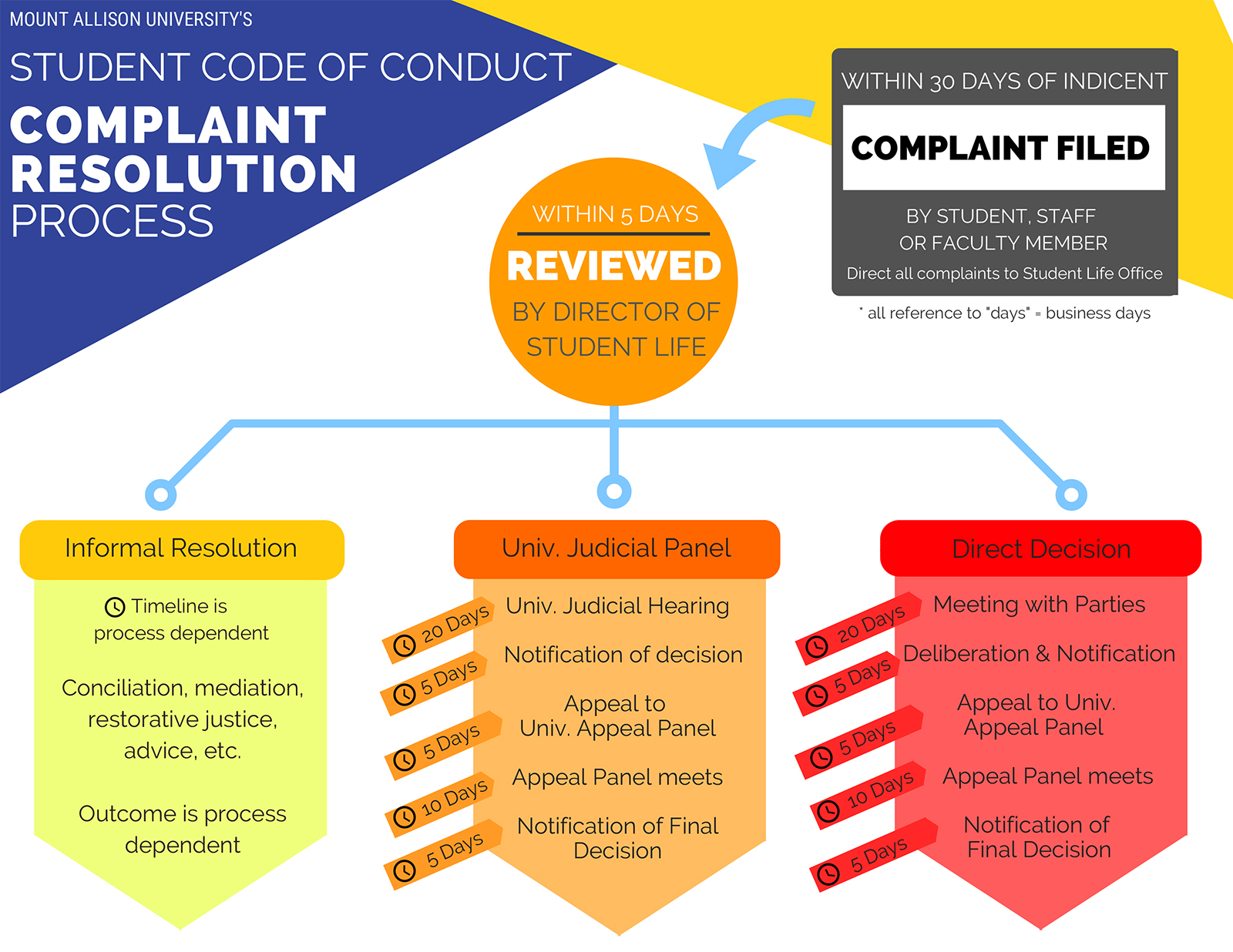
If a concern cannot be addressed directly, or direct communication is not appropriate, individuals may submit a Community Standards Concern Form to Student Affairs. The form requires Mount Allison credentials to complete and can be accessed at the following link: Community Standards Concern Form
Concerns must normally be submitted within 30 days of the incident in question. Anonymous complaints will not be processed. The Community Standards Case Manager will aim to respond to concerns within 10 business days of the submission. This is our standard response timeframe; however, response times may vary depending on the nature and complexity of the concerns.
Any member of the University community (e.g. student, staff, faculty) may submit a concern. For questions, please contact Community Standards & Conduct at conduct@mta.ca
Complaint resolution process
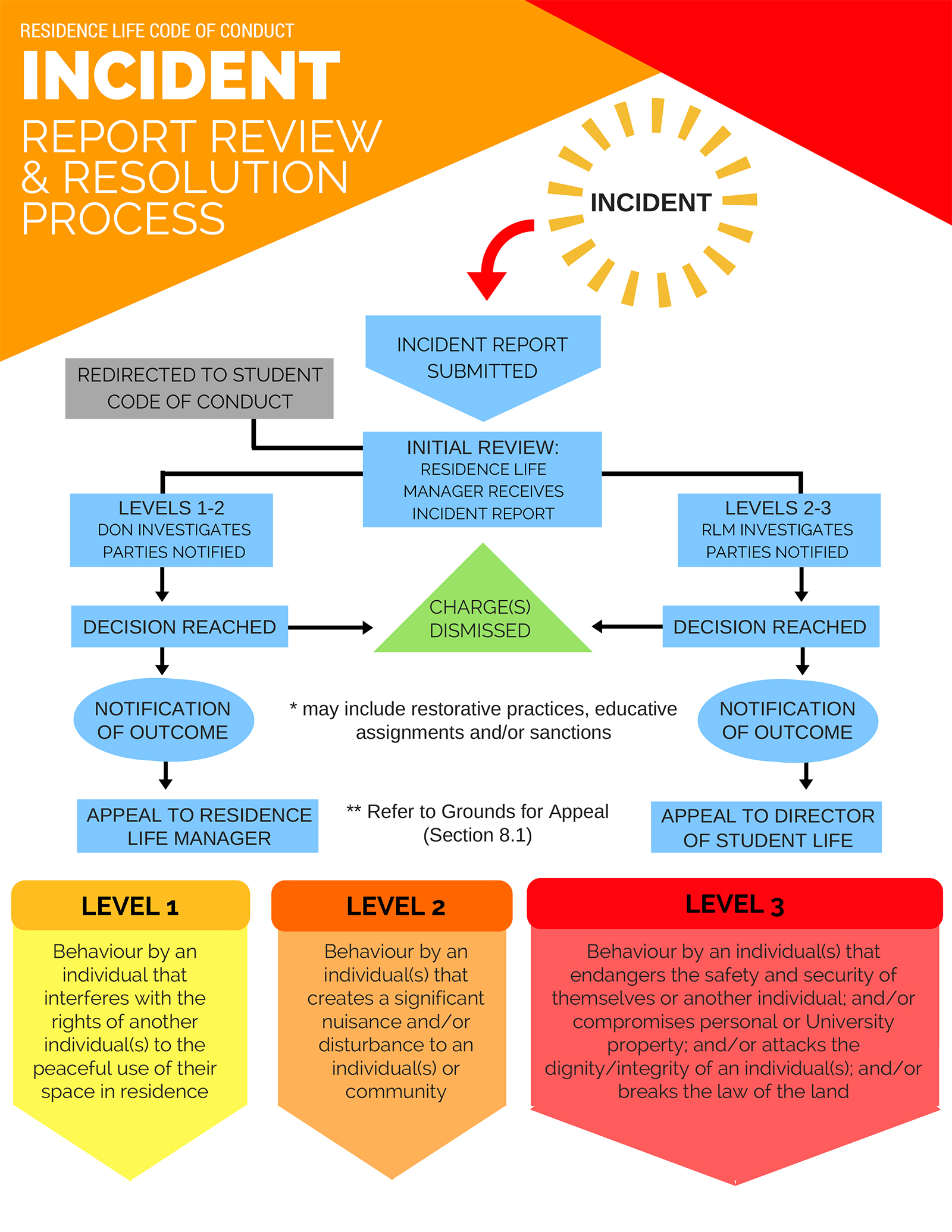
For complaints against faculty or staff, please contact the Mount Allison People & Culture department at hr@mta.ca.
Contact us
Student Life
Email: studentlife@mta.ca
Phone: (506) 364-2255
Fax: (506) 364-2263
Hours
Monday-Friday
8:30 a.m.-4:30 p.m. (closed 12-1 p.m.)
Summer hours (Victoria Day-Labour Day)
8:30 a.m.-4:00 p.m.
Location
Wallace McCain Student Centre (2nd floor)
62 York Street
Sackville, NB E4L 1E4