

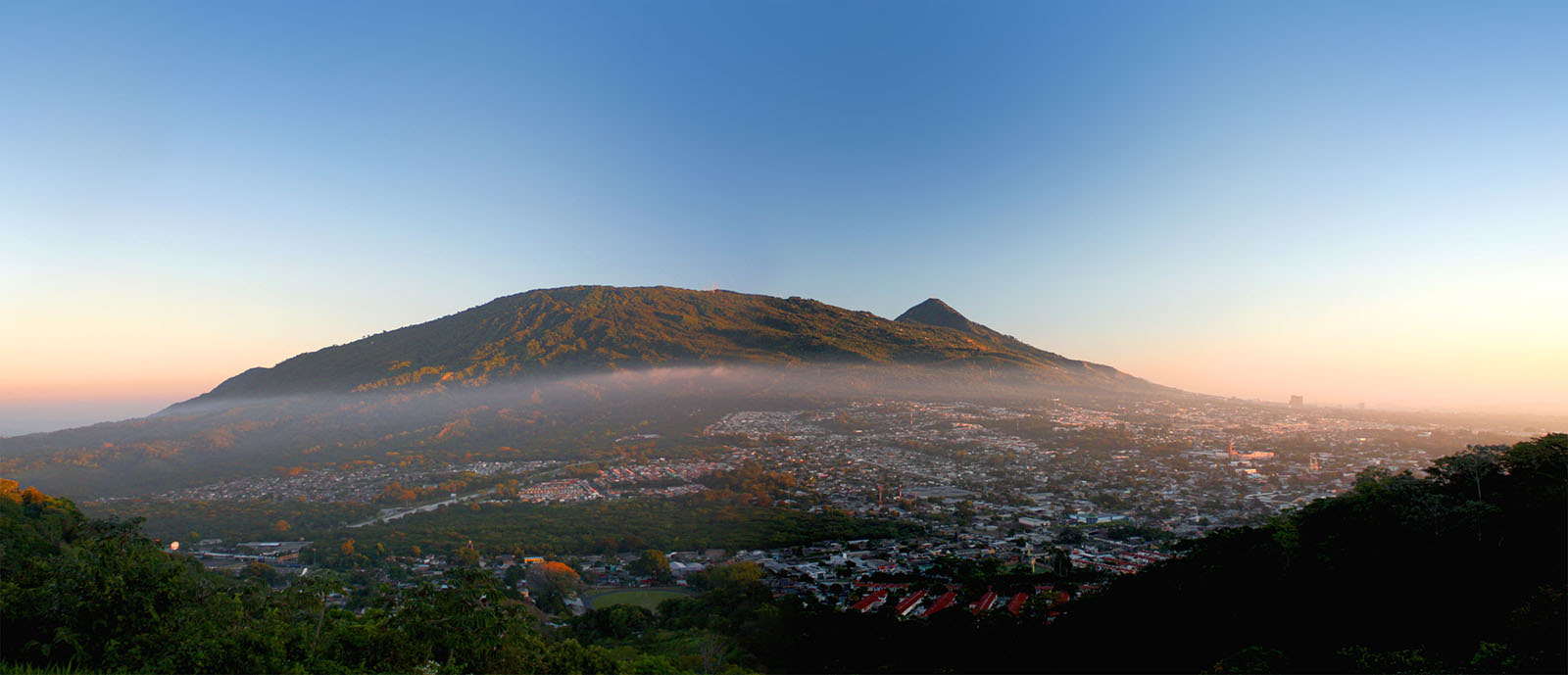
Join us in El Salvador this May/June 2026 for an immersive international field school exploring the intersections of historical memory, environmental challenges, and social movements. Engage with local leaders, visit community-driven sustainability initiatives, and uncover the complex drivers of migration in a region shaped by resilience and change. Expand your global perspective while learning firsthand from those creating solutions to socio-economic and environmental vulnerabilities.
Dates
- Class meeting dates: May 19, 21, June 4, 11 (2-hour seminars on Teams)
- Trip to El Salvador: May 24–June 2, 2026
Program overview
This unique international educational opportunity will provide students with an opportunity to complete selected background reading, followed by an 8-day trip (not including travel days) to El Salvador to learn directly from Salvadoran community leaders at the forefront of the struggle for environmental and social justice. Students will keep a daily journal of field notes while we are in El Salvador.
When they return from El Salvador, students will devise an individualized bibliography of readings, engage in intensive individual research that will culminate in summary research/project presentation composed of a multi-media project and accompanying paper of 1,000 words.
Learning objectives:
This course examines the intersections between: historical memory; environmental crisis; contemporary social movements; and displacement and migration.
- Learn about the drivers of migration in El Salvador in the context of socio-economic and environmental vulnerabilities.
- Learn about the role of social movements and civil society organizations in shaping the history and collective memory of the country.
- Meet with leaders of local organizations and visit local economic initiatives that foster sustainability and seek local solutions to socio economic vulnerabilities.
El Salvador Field School Application
APPLICATION DEADLINE EXTENDED: FEB. 2, 2026
Synopsis of course content
As the country of El Salvador continues to recover from a long and bloody civil war (1980-1992), a growing body of scientific evidence suggests that it could be heading towards an environmental crisis if drastic measures are not taken to reverse degradation caused by pollution, deforestation and the chronic dependence on carbon fuels, pesticides and other agro-toxics.
This course examines the intersections between: Historical Memory; Environmental Crisis; Contemporary Social Movements; and Displacement and Migration. As community groups work to commemorate wartime massacres, strengthen democratic processes, and maintain control of their territories, they also face environmental threats ranging from the incursion of multinational mining companies to the privatization of water.
The perspectives for environmental recovery are challenging. With a territorial extension of only 20-thousand square kilometres, El Salvador is the smallest country in Central America and the most densely populated country in the hemisphere. The national levels of soil erosion are high due to its geographic location and the fact that more than 90% of the national territory is deforested.
In 2010, a water quality study on surface water resources conducted by the Ministry of the Environment and Natural Resources (MARN) concluded that only 2% of the country`s surface water is fit for human consumption and for the growth of aquatic life. The country placed number four in a 2012 report by German Watch of the 10 countries most affected by climate change. The report further claims that El Salvador is regularly featured on the list due to its frequent exposure to the impacts of the Atlantic hurricane season.
Another report by the Global Facility for Disaster Reduction and Recovery claims that almost 90% of the national territory of El Salvador is presently at risk to extreme weather phenomena, 95% of the population live in risk zones, and 96% of Salvadoran gross domestic product (GDP) is produced in risk zones.
Salvadoran government authorities have taken notice of the crisis and have begun to take measures to foster long-term sustainability, but with an economy crippled by inequality, unemployment, codependence on foreign aid, globalized markets, and the legacy of a violent past, environmental conflicts threaten to bring further instability to the country.
Faculty-led study abroad component
The course includes an 8-day study abroad component in El Salvador from May 24–June 2 co-led by Dr. Morgan Poteet and ACAFREMIN Coordinator, Pedro Cabezas.
Assignments
- Quality of Participation (10%)
- Travel Journal, due June 4 in Moodle Drop Box– no extensions (25%)
- Annotated Bibliography & Individualized Research Plan, due in Moodle Drop Box by 11:59pm on June 5 (10%)
- Presentation: Presentation of Multimedia Project on June 11, 10 minutes long (15%)
- Final Research Project: Final short paper (1000 words) explaining content and methodology, due in Moodle Drop Box on June 18 at 11:59pm (40%)
Paper format
Students will be penalized for improper grammar, spelling, and formatting. Papers should be 1.5 spaced or double-spaced. Include a word count at the end of the essay. Please use APA style.
Late papers and missed in-class assignments
Papers are due at the beginning of class on the assigned due date. Late papers without accompanying documentation of illness or emergency will receive a penalty of 5% a day. After 7 days, the paper will receive a grade of 0.
*ADAPTED FROM “ENVIRONMENTAL CRISIS IN EL SALVADOR,” AMANDA GRZYB, WESTERN UNIVERSITY
Detailed schedule
MAY 19 — MEETING #1: Introductions
- Introduction to the group
- Overview of pre-departure training; trip itinerary; student responsibilities and guidelines; trip preparations and recommended packing list
Historical overview and context
- UN Truth Commission for El Salvador final report, “From Madness to Hope” (1993): https://www.usip.org/sites/default/files/file/ElSalvador-Report.pdf
- Eduardo Galeano, The Open Veins of Latin America: Five Centuries of the Pillage of a Continent (read entire book)
- Miguel Huezo Mixco, “The Vulnerable Imagination: Diaspora and Natural Disasters in Salvadoran Culture”
MAY 21 — MEETING #2: Environmental Issues in El Salvador: from Mining to Sugar Cane
- Thomas R. Hughes, Jose Roberto Acosta, Jaime Lochhead, “Large-Scale Sugarcane Production in El Salvador” (2016): https://voiceselsalvador.files.wordpress.com/2016/05/large-scale-sugarc…;
- Materials from Bluestone Resources/Cerro Blanco TBA to be posted to Moodle
- Jennifer Moore & Stuart Kirsch, “Mining, Corporate Social Responsibility, and Conflict: OceanaGold and the El Dorado Foundation in El Salvador”(2016): https://ips-dc.org/mining-corporate-social-responsibility-conflict-ocea…;
- Robin Broad & John Cavanagh, “Poorer Countries and the Environment: Friends and Foes” (2015): https://www.sciencedirect.com/science/article/pii/S0305750X15000662
- Damien Kingsbury, “Gold, Water, and the Struggle for Basic Rights in El Salvador” (2014): https://www.business-humanrights.org/es/node/105644
- Zakrison et al, “The Perceived Consequences of Gold Mining in Postwar El Salvador: A Qualitative Study” (2015): https://www.ncbi.nlm.nih.gov/pmc/articles/PMC4605151/
- Osgoode Hall Law School, REPORT: The Canada Brand: Violence and Canadian Mining Companies in Latin America (2016): https://papers.ssrn.com/sol3/papers.cfm?abstract_id=2886584
MAY 24-JUNE 2 — 8 DAYS IN EL SALVADOR
JUNE 4 — MEETING #3: Trip Debriefing
- Debriefing activity: share one photo or object to focus your reflection on what you learned on the trip
- Discussion about final projects/papers
- Travel Journal due June 4 (no extensions)
- Annotated Bibliography and Individual Research Plan due June 5 on Moodle
JUNE 11 — MEETING #4: Presentations
- Multimedia projects (10 min. each)
- Final paper due June 18 on Moodle
Enrolment: Students are enrolled in this course by special permission of the instructor
Professor: Dr. Morgan Poteet, Sociology
Academic credit: SOCI 3331 (3 credits) El Salvador Society & Environ.
Number of students: Limited to 12 students in years 3/4 from across the University
Program fee: The trip will cost (CAD):
- $2,200 includes in-country costs such as accommodation, food, transportation, speaker fees, etc. (paid to MtA)
- $800 round-trip flight (approx.) from Toronto to San Salvador (paid to MtA if booked by MTA or paid independently)
- $1,000 tuition for one 3-credit course (paid to MtA)
Questions? Contact Dr. Morgan Poteet, Department of Sociology, at mpoteet@mta.ca.
Funding for travelDid you know? Travel opportunities at Mount Allison are made more affordable through travel grants, bursaries, and awards that can help pay for your experience. Find out more about applying for funding for travel. |