
Mount Allison researchers receive more than $750,000 in NSERC funding
Five Mount Allison University researchers have received a combined $751,150 from the Natural Sciences and Engineering Research Council of Canada (NSERC) to advance research across a wide range of scientific fields.
The funding was announced as part of a national investment of more than $630 million in Canadian research. Through its Discovery Research Program, NSERC is supporting researchers as they pursue new ideas, contribute to scientific and technological advances, and create meaningful research and training opportunities for students.
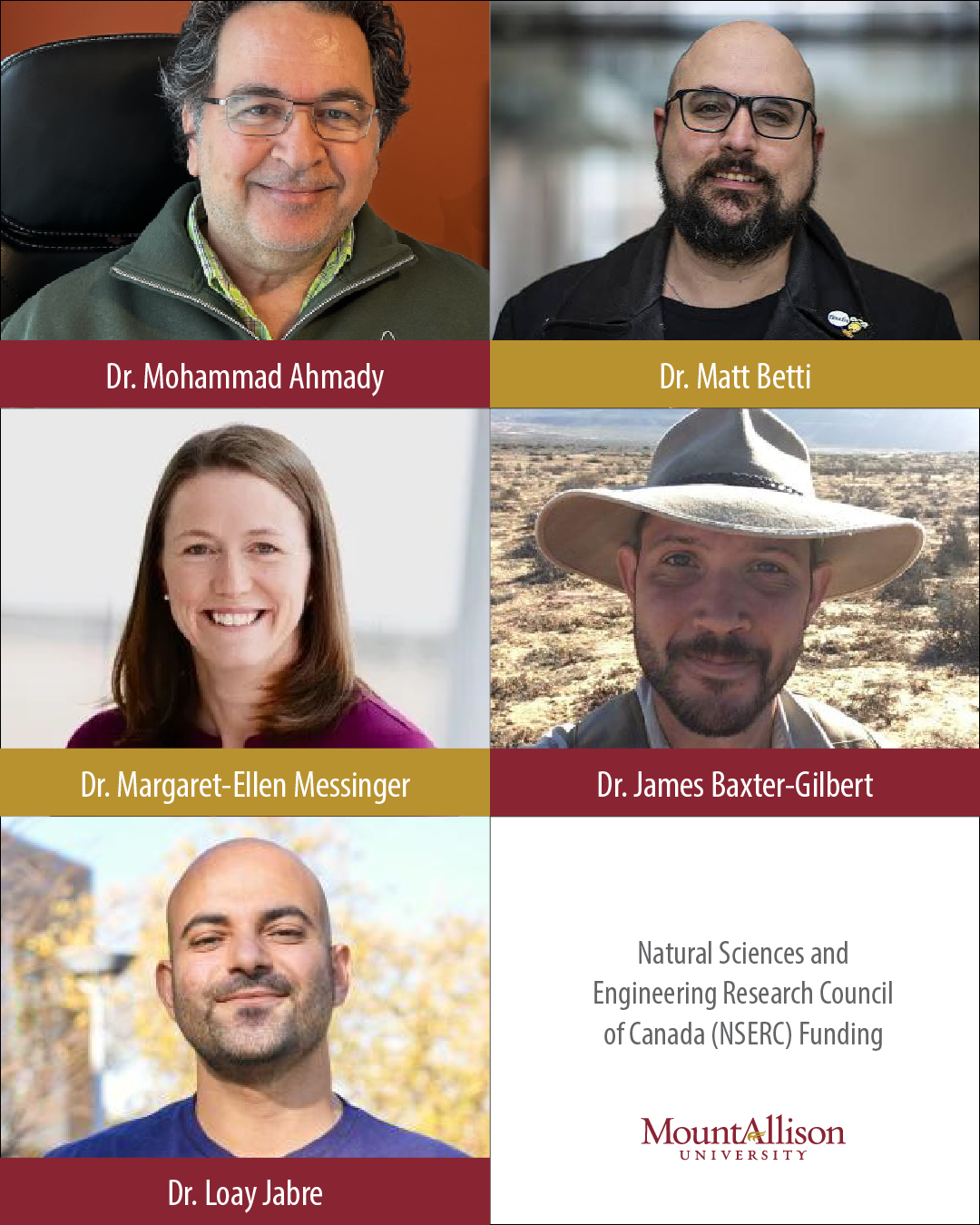
Biology Assistant Professor Dr. James Baxter-Gilbert has received a five-year, $220,000 Discovery Grant for his project, Evolutionary Resilience to Novel Landscapes: How Wildlife Overcome the Challenges of Anthropogenic Change. He will also receive a $12,500 Discovery Launch Supplement, bringing the total value of his award to $232,500.
An evolutionary ecologist and herpetologist, Baxter-Gilbert studies how wildlife responds and adapts to environments increasingly shaped by human activity. His work brings together conservation, evolution, urban ecology, and invasion biology, with a focus on finding practical ways to address ecological challenges.
Biology Assistant Professor Dr. Loay Jabre has received a five-year, $190,000 Discovery Grant for Metabolism across scales: from cells to the ocean, along with a $12,500 Discovery Launch Supplement.
Jabre’s research explores the connections between some of the ocean’s smallest organisms and much larger processes in marine ecosystems. His lab studies marine microorganisms, particularly phytoplankton, to better understand how their activity at the cellular level influences ocean chemistry and broader Earth systems.
Mathematics and Computer Science Professor Dr. Margaret-Ellen Messinger has received $132,150 over five years for her project, Contagion dynamics and reconfiguration in graphs.
Messinger’s research sits at the intersection of mathematics and theoretical computer science. By studying how activity spreads and changes within networks, her work can help build a deeper understanding of complex systems and the mathematical structures behind them. She also regularly involves undergraduate students in her research and publications.
Mathematics and Computer Science Associate Professor Dr. Matt Betti has received a two-year, $44,000 Discovery Development Grant for Data-driven models of changing ecological and evolutionary systems.
Betti develops mathematical models to help understand how biological systems respond to change. His research brings together mathematics, data, ecology, and evolution to explore patterns that can be difficult to study through observation alone.
Physics Professor Dr. Mohammad Ahmady has received $140,000 over five years through NSERC’s Subatomic Physics Grants program for his project, Holographic QCD and vector-like quarks in rare B decays.
Ahmady’s work in theoretical particle physics explores the fundamental particles and forces that make up the universe. His research focuses on questions related to heavy quarks, strong interactions, and the Standard Model of particle physics.
About NSERC
NSERC Discovery Grants provide long-term support for ongoing research programs while creating opportunities for students and early-career researchers to develop valuable skills. The 2026 national funding announcement includes $546.4 million in individual Discovery Grants, $23.7 million for subatomic physics research, and $2.5 million in Discovery Development Grants supporting researchers at small universities across Canada.