
Student research: Investigating an invasive toad species in Newfoundland
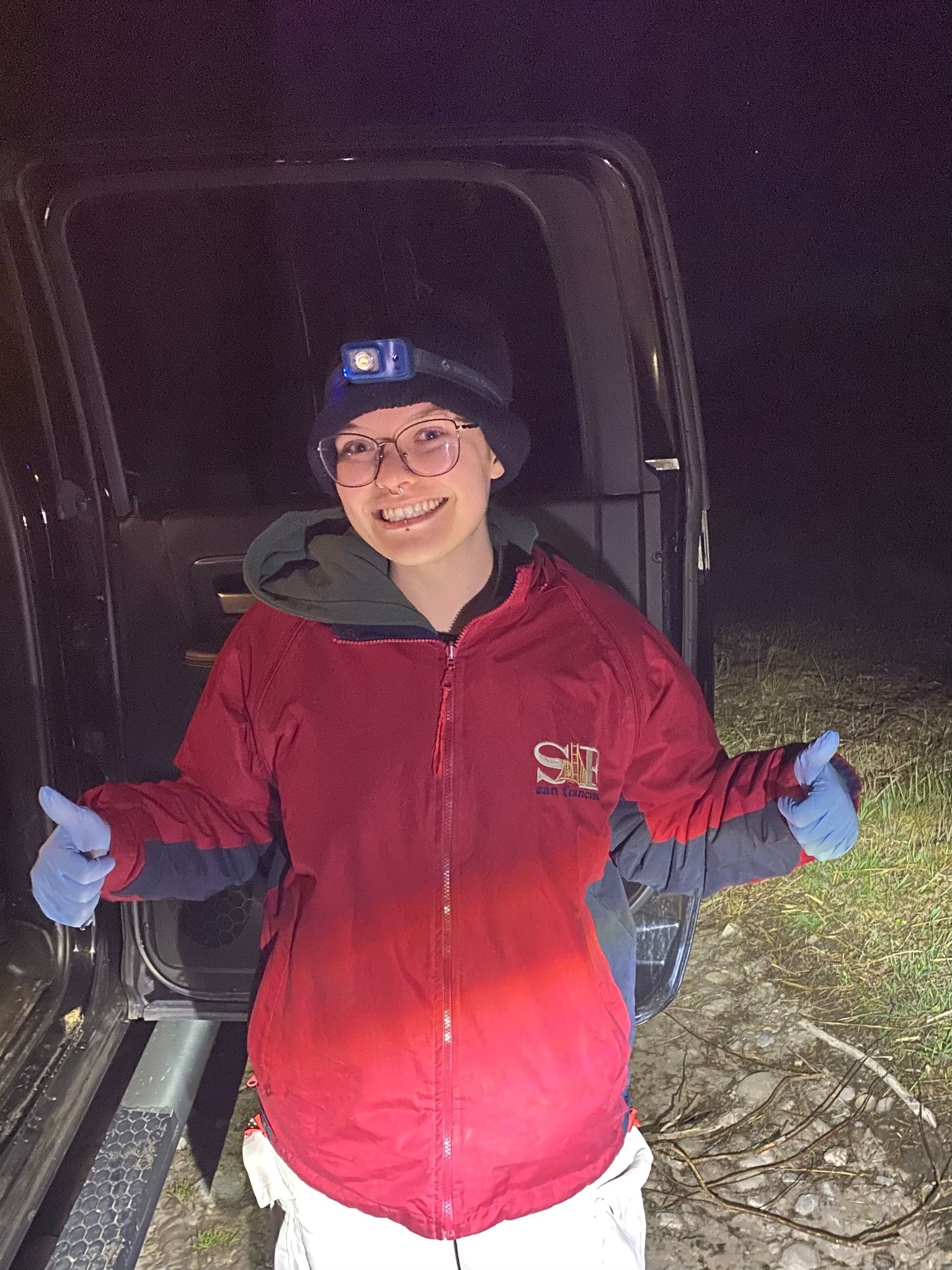
For five weeks this summer, Mount Allison University student Julie Stote’s classroom was the west coast of Newfoundland, where her field research included collecting toads (by hand!) to study.
Stote, a fourth-year biology major from Cormier Village, NB, is studying the diet and foraging behaviour of the American toad, an invasive species introduced to Newfoundland in the 1960s.
Despite having lived on the island for decades, not a lot is known about what the toads eat, how they interact with native ecosystems, or what may have helped them become such successful invaders.
Stote hopes her honours research can help fill some of those gaps.
“By looking at their diet, I hope to gain a better understanding of how native species may be affected, how these toads may influence native food webs, and whether management efforts should focus on controlling toad populations or protecting vulnerable native species,” she says.
After five weeks of field research, she is now comparing what the toads ate with what was available in their environment, so she can determine whether they are consuming prey in proportion to availability or actively favouring particular species.
Her findings will be shared with Newfoundland and Labrador’s provincial Wildlife Division to help inform threat classifications and management strategies. She also plans to use her results as part of an international framework for assessing the environmental impacts of invasive species.
The project will form the basis of Stote’s honours thesis, but she hopes to take the research further through a peer-reviewed article and a presentation at the Canadian Herpetological Society conference.
“Being able to take my project beyond just my thesis and share it with the broader scientific community as an undergraduate is an invaluable opportunity, uniquely supported by Mount Allison and the ISRG program,” she says.
Alongside her biology major, Stote is completing a minor in feminist and gender studies, an academic combination she says has encouraged her to approach research from different perspectives.
“The liberal arts and sciences education I received at Mount Allison has allowed me to explore passions outside of STEM and incorporate interdisciplinary perspectives into my research project,” she says.
After graduating in 2027, Stote plans to pursue a master’s degree in biology and continue conducting research. For now, the hundreds of specimens collected in Newfoundland are providing both the foundation for her honours thesis and an early glimpse of the career she hopes to build.
“Funding from the ISRG has allowed me to take a crucial first step in my development as a researcher,” she says, “and has meaningfully prepared me for a long-term career in academic research.”
Stote’s research was made possible through the Mount Allison Independent Student Research Grant (ISRG), funded by NSERC USRA.